










Moscow Center of Advanced Sports Technologies (Sports Psychology Department, physiologist)
Moscow, Russian Federation
employee
Moscow, Moscow, Russian Federation
Russian Federation
Federal Research Center for Original and Prospective Biomedical and Pharmaceutical Technologies (Laboratory of Rehabilitation and Sports Psychophysiology, researcher)
employee
Podolsk, Russian Federation
VAK Russia 5.8.5
UDC 159.91
UDC 796.89
CSCSTI 15.81
CSCSTI 77.00
Russian Classification of Professions by Education 06.00.00
Russian Classification of Professions by Education 09.00.00
Russian Classification of Professions by Education 32.00.00
Russian Library and Bibliographic Classification 58
Russian Library and Bibliographic Classification 75
Russian Trade and Bibliographic Classification 5
BISAC COM032000 Information Technology
BISAC PSY045000 Movements / General
BISAC PSY024000 Physiological Psychology
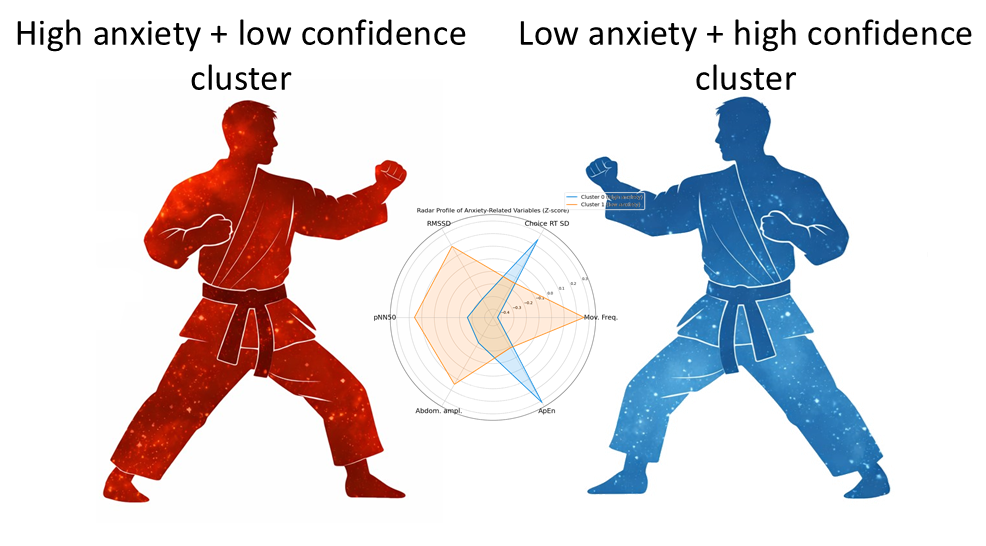
Relevance. The association between competitive anxiety and heart rate variability (HRV) remains inconsistent, especially when athletes are evaluated outside the immediate pre-competition period. Objective. To examine relationships between competitive anxiety and autonomic, respiratory, and sensorimotor regulation in martial arts athletes during a non-competitive training phase. Methods. Forty athletes (aged 16–27) who practice karate, kyokushin, wushu, or taekwondo were assessed during regular training sessions. Competitive anxiety was measured using the Competitive State Anxiety Inventory-2 (CSAI-2). Resting photoplethysmography (5-minutes, seated) was recorded to calculate linear and nonlinear heart rate variability (HRV) indices, as well as respiratory parameters. Sensorimotor performance was assessed using a battery of visual-motor tasks. All variables were standardized using z-scores. Correlation analysis, k-means clustering, and PERMANOVA were used for analysis. Results. No significant correlations were found between anxiety subscales and autonomic or sensorimotor indicators. Cluster analysis identified two psychological profiles: a group with higher anxiety and lower confidence, and a more adaptive group with lower anxiety and higher confidence. Although univariate differences did not reach statistical significance, the group with higher anxiety showed consistent trends towards lower vagal activity (RMSSD, pNN50), reduced abdominal respiratory amplitude, reduced autonomic complexity, and increased variability in choice reaction time. Multivariate analysis suggested a trend towards differentiation of integrated psychophysiological profiles (p=0.08). Conclusion. In non-competitive conditions, anxiety was not related to individual physiological markers, but rather reflected in integrated, multivariate configurations. These findings emphasize the significance of multidimensional approaches in sports psychophysiology.
competitive anxiety, martial arts athletes, heart rate variability (HRV), sensorimotor functions, permutation-based multivariate test
1. Fortes L.S., da Costa B.D.V., Paes P.P., do Nascimento J´unior J.R.A., Fiorese L., Ferreira M.E.C. Influence of competitive anxiety on heart rate variability in swimmers. Journal of Sports Science and Medicine, 2017, 16 (4), pp. 498–504. URL: https://www.jssm.org/jssm-16-498.xml%3EFulltext
2. Cervantes Bl´asquez J.C., Rodas G., Capdevila Ort´ıs L. Heart-rate variability and precompetitive anxiety in swimmers. Psicothema, 2009, 21 (4), pp. 531–536. URL: https://www.redalyc.org/pdf/727/72711895005.pdf
3. Zhao C., Wang K., Li D., Li Y., Wang Z., et al. Relationship between state anxiety, heart rate variability, and shooting performance in adolescent shooters. BMC Psychology, 2024, 12 (1), 736. https://doi.org/10.1186/s40359-024-02062-4
4. Villafaina S., Crespo M., Mart´ınez-Gallego R., Fuentes-Garc´ıa J.P. Heart rate variability in elite international ITF Junior Davis Cup tennis players. Biology (Basel), 2022, 12 (1), 17. https://doi.org/10.3390/biology12010017
5. Souza R.A., Beltr´an O.A.B., Zapata D.M., Silva E., Freitas W.Z., et al. Heart rate variability, salivary cortisol and competitive state anxiety responses during pre-competition and pre-training moments. Biology of Sport, 2019, 36 (1), pp. 39–46. https://doi.org/10.5114/biolsport.2018.78905
6. Mallory J., Marshall A.H., Williams M., Heilman J., Shoemaker M.K., Walbolt J. Effects of personality and competition anxiety on heart rate variability and salivary stress markers. International Journal of Exercise Science: Conference Proceedings, 2023, 16 (2), 29. URL: https://digitalcommons.wku.edu/ijesab/vol16/iss2/29
7. Lapo H.M., Chacon-Mikahil M.P.T., Sardeli A.V. Psychophysiological factors are not directly associated with heart rate variability in athletes: A meta-analysis. Journal of Mental Health & Clinical Psychology, 2024, 8 (3), pp. 7–16. https://doi.org/https://doi.org/10.29245/2578-2959/2024/3.1323
8. Bochaver K.A., Bondarev D.V., Dovzhik L.M. Psikhologicheskaya diagnostika v sporte [Psychological assessment in sport]. Moscow: Sport, 2023, 232 p. (in Russ.)
9. Terry P.C., Slade A. Discriminant effectiveness of psychological state measures in predicting performance outcome in karate competition. Perceptual and Motor Skills, 1995, 81 (1), pp. 275–286. https://doi.org/10.2466/pms.1995.81.1.275
10. A˘gao˘glu Y.S. Responses to the Competitive State Anxiety Inventory-2 by the athletes participated in the (IJF) Judo Grand Prix competition, Samsun 2015 in Turkey. International Journal of Environmental & Science Education, 2016, 11 (10), pp. 3259–3275.
11. Mojtahedi D., Dagnall N., Denovan A., Clough P., Dewhurst S., et al. Competition anxiety in combat sports and the importance of mental toughness. Behavioral Sciences (Basel), 2023, 13 (9), 713. https://doi.org/10.3390/bs13090713